920 sq km. 22 villages. 6 Town Planning schemes. A city that was drawn on paper before a single road was built, and designed by the people who built Dubai's Palm Jumeirah.
Ahmedabad grew over centuries. Mumbai grew because of a port. Bangalore grew because of IT. None of them were planned, they just happened, and then everyone spent decades trying to fix the traffic, the drainage, the power cuts.
Dholera is different. The Gujarat government and DMICDC decided to build a city from scratch, and they started with the plan, not the buildings. In 2009, they hired Halcrow Group to design the whole thing. Halcrow was founded in 1868 in the UK. They built Mulberry Harbours for the D-Day landings in World War II. They designed the London Underground's Victoria Line. They dredged Dubai Creek in the 1950s and turned a pearl-trading town into a shipping hub. They built Port Rashid, then Jebel Ali, the world's largest man-made harbor. Then they designed Palm Jumeirah: 90 million cubic meters of sand and rock arranged into a palm-shaped island. When the Gujarat government needed someone to master-plan a city on the Gulf of Khambhat, with tidal conditions that swing 11 meters twice a day, Halcrow was the obvious choice.
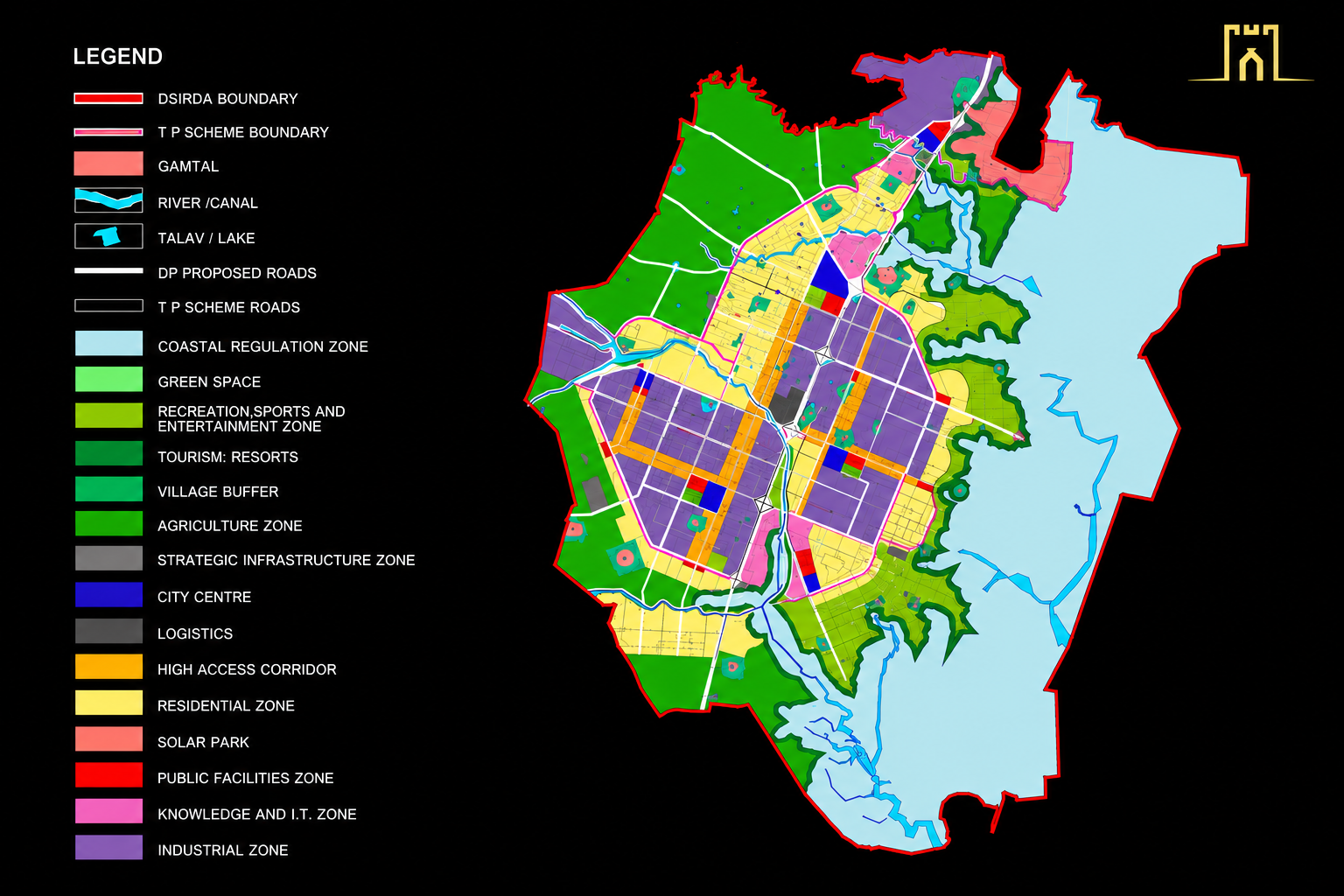
The master plan was finished in 2010. It covers 920 sq km, bigger than Singapore. Of that, 422 sq km is actively zoned for development across 6 TP schemes. The rest is reserved for future expansion, conservation, and buffer zones. AECOM, an American infrastructure firm, was brought in to handle the actual execution.
What makes this plan worth reading about is the philosophy behind it: build the infrastructure first, then invite people in. Not the other way around.
Halcrow didn't just draw a map. They understood the coastal engineering challenge. The Gulf of Khambhat has tidal swings of 11 meters, some of the most extreme conditions in the world. Building a city on this coastline requires infrastructure that can handle saltwater intrusion, storm surges, and massive tidal flows. Halcrow had already solved these problems in Dubai and Abu Dhabi. They brought that expertise to Dholera.
Their master plan created 12 core zones with strict segregation: residential, commercial, industrial, logistics, and recreational areas each have their own dedicated space. Six sub-centers provide localized services so residents don't need to travel across the city for daily needs. Every road, utility line, and building footprint is tracked through BIM and GIS systems. This is not a sketch on paper. It is a precision-engineered plan for a city that will house 2 million people.
Before Dholera became a "smart city," it was home to 22 villages spread across the Gulf of Khambhat coastline. These villages (Kadipur, Dholera, Bhadiyad, Mundi, Hebatpur, and others) are now part of the development area. The land pooling model means landowners contribute roughly half their land and get back developed plots in return. No compulsory acquisition. No displacement.
Each TP scheme covers a specific set of villages. TP 2, the most advanced phase, includes 10 villages. TP 1 covers 4. The scheme-by-scheme village breakdown is on our TP Schemes page.
The plan splits the development area into zones. Each zone has its own building rules, FSI limits, and permitted uses. The idea is simple: keep heavy industry away from residential areas, put the CBD where it's accessible, and leave enough green space so the city doesn't feel like a factory floor.
Nearly half the land. This is where Tata's semiconductor fab, aerospace parks, and manufacturing units sit. The largest industrial zone in any Indian smart city.
Housing for up to 2 million people. Schools, hospitals, parks, and markets are built into the plan, not added later when things get crowded.
Offices, malls, hotels, and civic buildings. Walkable, mixed-use, designed to be the commercial heart of the region.
Major road frontage zones with mixed-use development. Commercial, retail, and offices along Dholera's main arteries.
Tech companies, research labs, and startups. Connected to the education district that Gujarat is building on 1,000 acres nearby.
Stadiums, cultural centers, parks. Because a city needs places to play, not just places to work.
Lothal, the world's oldest known tidal dock, built around 2400 BCE, is right next door. Heritage tourism and eco-tourism along the coast.
Farmland and green corridors that stay green. They're not "leftover" land, they're part of the ecological balance.
Built on CRZ-1B mudflats. One of the largest solar installations in the world. Powers the entire region with clean energy.
In most Indian cities, infrastructure comes after the buildings. Roads are dug up to lay cables. Drains overflow because they were never designed for this population. Power goes out because the grid wasn't built for this demand.
Dholera flipped the sequence. Before a single plot was sold, the infrastructure was already in place: 250 km of underground utility corridors, a water treatment plant, sewage treatment, waste-to-energy, fiber-optic backbone, and a SCADA command center monitoring everything in real time.
Here's what's actually built:
Precast concrete corridors carrying power, water, gas, sewage, and telecom, all underground, all accessible without digging up roads. Built by Fuji Silvertech with corrosion-resistant rubber gaskets for the saline coastal environment.
Every drop of industrial wastewater is treated and recycled. 81 km of recycled water pipeline. The target is less than 5% water loss, compared to 30%+ in most Indian cities.
A 28-hectare solid waste facility handles 25 tonnes per day. Segregation, bio-methanation, and high-temperature incineration convert garbage into electricity and process steam.
Real-time monitoring of every utility. Smart meters, pressure sensors, automated leak detection. The ABCD Building houses the Integrated Command and Control Center that watches over all of it.
Torrent Power manages the grid. Subterranean cabling, zero overhead lines. Designed for zero downtime, because a single microsecond voltage drop can halt a semiconductor fab.
Narmada canal water comes in through a dedicated transmission main. A 50 MLD treatment plant (scalable to 150 MLD) splits it into potable and recycled streams. Dual pipeline, closed loop.
Dholera isn't just factories and fabs. Gujarat is building a 1,000-acre Special Education Region (G-SER) with seven specialized institutions, from nanotechnology to renewable energy to medical sciences. The first school and multi-specialty hospital were inaugurated in March 2025 by CM Bhupendra Patel. AI-powered classrooms, STEM labs, solar rooftops. The kind of school you'd expect in a tech hub, not a greenfield city.
The education district alone is expected to create 150,000 to 250,000 direct and indirect jobs. By the time the first residents move in, the social infrastructure (schools, hospitals, hotels, retail) will already be there.
The 422 sq km development area is split into 6 Town Planning schemes. Each one is self-contained, it has its own roads, water supply, power, and sewage. They're built in sequence: TP 1 and TP 2 are furthest along, TP 3 and TP 4 are under construction, and TP 5 and TP 6 are in planning.
Full details on our TP Schemes page.
51 sq km. The knowledge corridor. Near-complete trunk infrastructure. 7 sub-TPs covering Kadipur, Ambli, Bhadiyad, and Gogla villages. Land rates: ₹2,900–₹3,200/sq yd.
102 sq km. The crown jewel. Fully operational activation area with ABCD Building, SCADA center, Tata Semiconductor Fab, and ReNew Solar Park. 8 sub-TPs. Land rates: ₹3,800–₹10,500/sq yd.
66 sq km. Workforce housing, EV infrastructure, sustainable transport. Basic grading underway. 4 sub-TPs. Land rates: ₹7,500–₹15,000/sq yd.
60 sq km. Adjacent to the solar park. Hospitals, government offices, schools. Bridges the industrial core with residential areas. 3 sub-TPs.
74 sq km. Large-scale manufacturing, chemical engineering, heavy industry. Direct freight corridor and port access. 4 sub-TPs.
67 sq km. The biggest sub-TP (6B at 60 sq km) is held for future residential expansion and ecological conservation. 10–15 year horizon.
22.54 sq km activation area. 95% infrastructure done. 75-meter arterial roads. ABCD Building and ICCC operational. First school and hospital inaugurated.
Tata semiconductor fab producing 50,000 wafers per month. Airport at full commercial operations. Expressway, rail, and port all connected. EV clusters from Tata Motors and MG Motors. Defense and aerospace parks under construction.
2 million residents. Metro and monorail running. Full TP scheme build-out. Complete industrial ecosystem with ancillary suppliers, logistics networks, and service economy.
Full 920 sq km activated. World-class skyline. International recognition. The city that was designed on paper in 2010 becomes a living, breathing metropolis.
Plots are available now in TP schemes that are already built or under construction. Pre-development prices won't last as industries move in and the population grows.
Enquire Now