5,000 MW solar park, wind corridors, and grid storage powering India's largest greenfield industrial city.
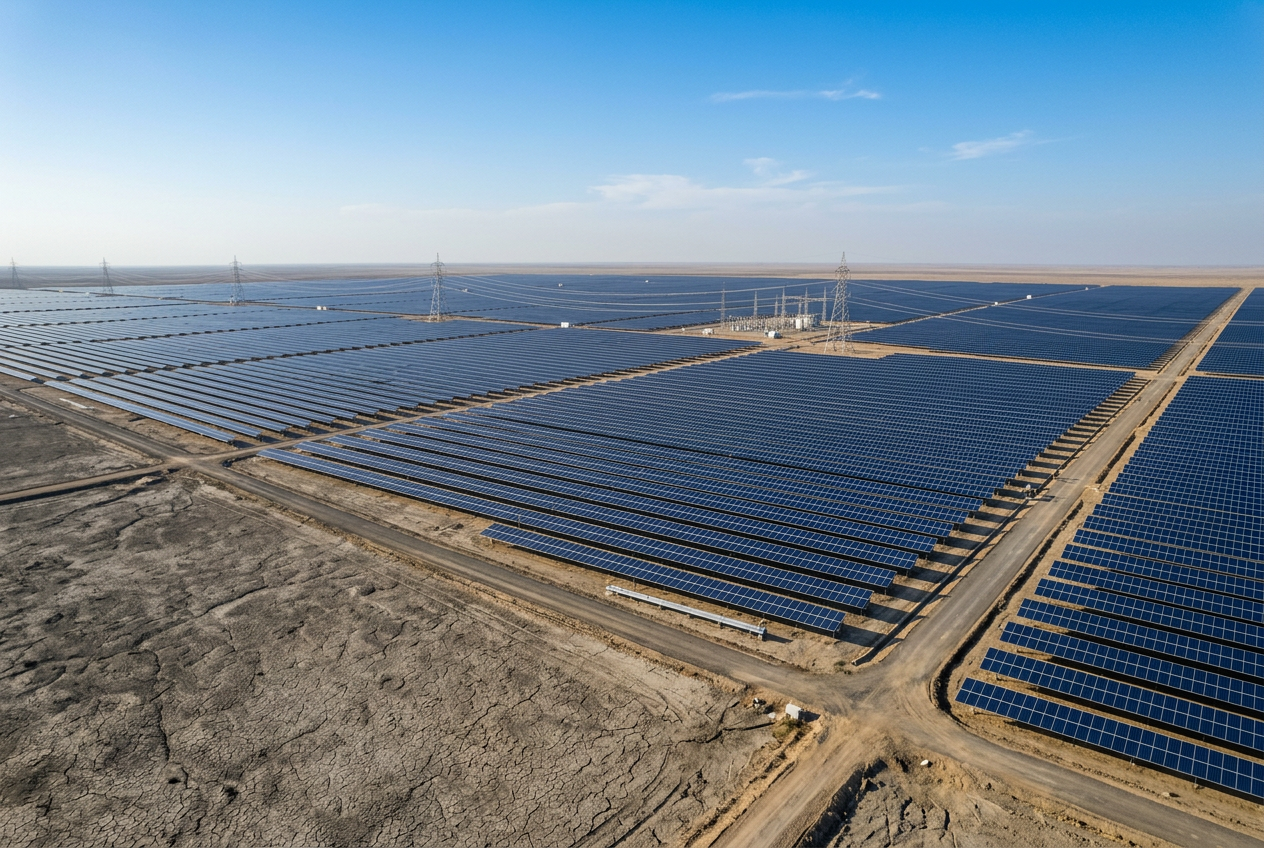
The Dholera Ultra Mega Solar Park spreads across 11,000+ hectares of CRZ-1B classified mudflats in the Gulf of Khambhat. CRZ-1B land is coastal zone land with no agricultural, residential, or commercial value. It sits unused. The park converts that unused coastline into a power source capable of generating 5,000 MW at full buildout, which represents roughly 1% of India's 500 GW non-fossil energy target for 2030.
The project is not being built as a single block. It is developing in three phases that allow grid infrastructure and generation capacity to scale together.
Phase 1 saw Tata Power Renewable Energy commission the first operational sub-segment in 2022. Additional Phase 1 capacity is under construction, with tenders awarded through GUVNL and SECI to developers including Tata Power and independent power producers. Phase 2 is in the planning and bidding stage, with capacity allocations being decided. Phase 3 forms the long-term pipeline, where SECI and GUVNL are coordinating international consortia and industrial offtakers. The full 5,000 MW target is expected by 2030. The staggered approach solves a real problem: India's larger solar parks have hit grid bottlenecks when too much capacity came online before transmission infrastructure was ready. Dholera avoids this by building both in parallel.
The transmission chain from panel to factory floor is purpose-built for industrial supply, not grid export.
Solar panels, both monocrystalline and polycrystalline modules mounted on single-axis trackers, generate electricity that feeds into a 49-kilometer underground 33kV saline-resistant cable network. That network connects panel arrays across the 11,000-hectare site to substations where voltage is stepped up from 33kV to 200kV for bulk transmission. From there, the power enters GETCO/POWERGRID 400kV lines that connect to the national transmission backbone.
At the local distribution level, Torrent Power manages 400/220 kV gas-insulated substations with 1,500 MVA capacity. GIS technology is essential here. Air-insulated substations corrode quickly in saline coastal environments. Gas-insulated units seal the critical components in sealed enclosures, keeping salt and moisture out. From these substations, electricity flows to industrial end-users: the semiconductor fab, data centers, manufacturing facilities, and the broader Dholera SIR industrial zone. The entire chain is monitored through SCADA systems that track power flow in real time.
The Gulf of Khambhat has some of the highest tidal ranges on Earth, over 11 meters at spring tide. Salt spray reaches far inland. The soil is saline. These conditions destroy standard solar park equipment. What works in Rajasthan's Bhadla Solar Park, the world's largest at 2,245 MW, would corrode and fail at Dholera within a few years.
So every component is specified for high-salinity operation. Underground cables use saline-resistant insulation rated for the specific chloride concentrations found in Gulf of Khambhat coastal soil. Burial depth accounts for tidal water table fluctuations. Cable jacketing resists chemical degradation from salt exposure. Junction boxes, combiner boxes, and transformer stations all meet saline environment specifications. Elevated tracker foundations raise the panels above the CRZ-1B flood line, keeping equipment above the highest tidal surge. Standard galvanized steel corrodes in these conditions. Dholera's trackers use marine-grade coatings and stainless steel hardware rated for decades of salt air exposure.
The result is a solar park where the electrical infrastructure has a realistic 25-year design life, matching the panel warranty period. Inland parks sometimes cut corners on electrical components because the environment is forgiving. Dholera does not have that luxury, and the engineering reflects it.
Dust accumulation on solar panels reduces output. In most installations, this is managed by washing panels with water. In Dholera, that approach fails for two reasons. Freshwater is scarce in the coastal zone, and existing groundwater is saline. Using saline water on panels would leave mineral deposits that cause more damage than the dust itself.
The park solves this with robotic cleaning systems that use no water. Automated robots traverse the panel surfaces on scheduled cycles, removing dust and debris mechanically. The robots ride along the panel edges, using brushes and suction to clear the surface without scratching the glass coating. They operate at night or during low-generation periods to avoid disrupting power output.
This approach eliminates water consumption for panel maintenance entirely. Over a 25-year panel lifecycle, that adds up to a significant savings in both water costs and the logistics of water supply in a remote coastal location. The robots also produce more consistent cleaning results than manual washing. Human cleaners tend to miss edges and corners. Robots do not.
Solar is the anchor, but Dholera's renewable energy ecosystem extends beyond photovoltaics. The Gulf of Khambhat corridor experiences consistent wind patterns driven by the funneling effect between the Gujarat mainland and the Kathiawar Peninsula. Average wind speeds in the 80-to-100-meter hub height range reach levels suitable for commercial wind generation, typically 7 to 8 meters per second.
Wind energy development along this corridor is at an earlier stage than solar, but the potential is substantial. Hybrid wind-solar configurations are particularly promising because wind generation often peaks when solar output drops. Evening and monsoon-period wind generation can fill gaps in the solar production curve, smoothing the overall supply profile and reducing the battery storage capacity needed for round-the-clock power.
The integration of wind into the Dholera renewable ecosystem also improves grid stability. A mix of generation sources with different output profiles produces a more predictable aggregate supply than any single source alone. This matters for industrial users who need consistent power, not just average power over a year.
Solar generates during daylight. Factories run 24 hours. That gap is where battery storage becomes essential.
The Dholera renewable ecosystem plans for grid-scale battery energy storage systems (BESS) that store excess solar generation during the day and discharge it during evening and nighttime hours. The storage capacity needed depends on the load profile of the industrial zone, but the direction is clear: storage is not optional when you are replacing baseload fossil generation with variable renewables.
Battery storage also provides grid services that improve power quality for industrial users. Frequency regulation, voltage support, and instantaneous load following are all functions that batteries perform faster than conventional generators. For semiconductor fabs and data centers, where power quality directly affects production yield, this fast response matters. A voltage dip that a conventional grid might tolerate can damage a wafer worth thousands of dollars. Batteries respond in milliseconds.
The economics of grid-scale storage have shifted significantly since 2022. Lithium iron phosphate (LFP) battery costs have fallen below $100/kWh at the pack level, making multi-hour storage commercially viable for the first time at the scale Dholera needs. The combination of low-cost solar generation and affordable storage creates a power cost structure that fossil fuel plants cannot match.
The next phase of Dholera's energy strategy looks at what happens when solar generation exceeds local demand. During peak production hours, the 5,000 MW solar park will produce more electricity than the industrial zone consumes. That surplus power has a destination: green hydrogen production.
Electrolyzers split water into hydrogen and oxygen using electricity. When that electricity comes from solar, the resulting hydrogen is green, with zero carbon emissions in production. Surplus daytime solar power can drive large-scale electrolysis, producing hydrogen that is stored and used later, either as a fuel for industrial processes, for power generation during low-solar periods, or as a feedstock for green ammonia and methanol production.
The planning for electrolyzer capacity is underway. Initial installations will likely target industrial offtakers within Dholera who need hydrogen as a process input. Data centers are also exploring hydrogen fuel cells as backup power, replacing diesel generators. The combination of abundant solar, existing water supply from the desalination infrastructure, and industrial demand makes Dholera a practical location for green hydrogen at commercial scale, not just a demonstration project.
The renewable ecosystem exists to serve the industries located within Dholera SIR. These are not general grid consumers. They are specific, committed projects with precise power requirements.
The semiconductor fabrication facility requires massive, continuous power supply with extremely tight quality tolerances. A power interruption or voltage fluctuation can destroy an entire production run of wafers. The solar park, combined with battery storage and grid-scale substations, provides the redundancy and quality these operations demand. Multiple power feeds, automatic failover, and real-time monitoring keep the fab running.
Data centers running AI training and cloud workloads have similar requirements, though they tolerate slightly more flexibility. They need high-density power delivery, efficient cooling (which is why Dholera's zero-liquid-discharge water system matters), and clean electricity that reduces their carbon footprint for ESG reporting.
Manufacturing facilities across the industrial zone draw from the same smart grid. The grid manages supply and demand in real time, prioritizing critical loads during peak demand and routing surplus generation to storage or hydrogen production during low-demand periods.
The key difference between Dholera's renewable ecosystem and India's other large solar parks is consumption. Bhadla, at 2,245 MW, exports power to the northern grid through long-distance transmission. Dholera's 5,000 MW park generates electricity that is consumed within walking distance of the panels. No long-distance transmission losses. No exposure to grid congestion. No dependence on distant offtakers. The power is generated where it is used, and the industrial users pay predictable, competitive rates for clean electricity over long-term power purchase agreements.
← Back to Industries