A $100 billion India-Japan partnership that makes Dholera a national priority, not a private experiment.
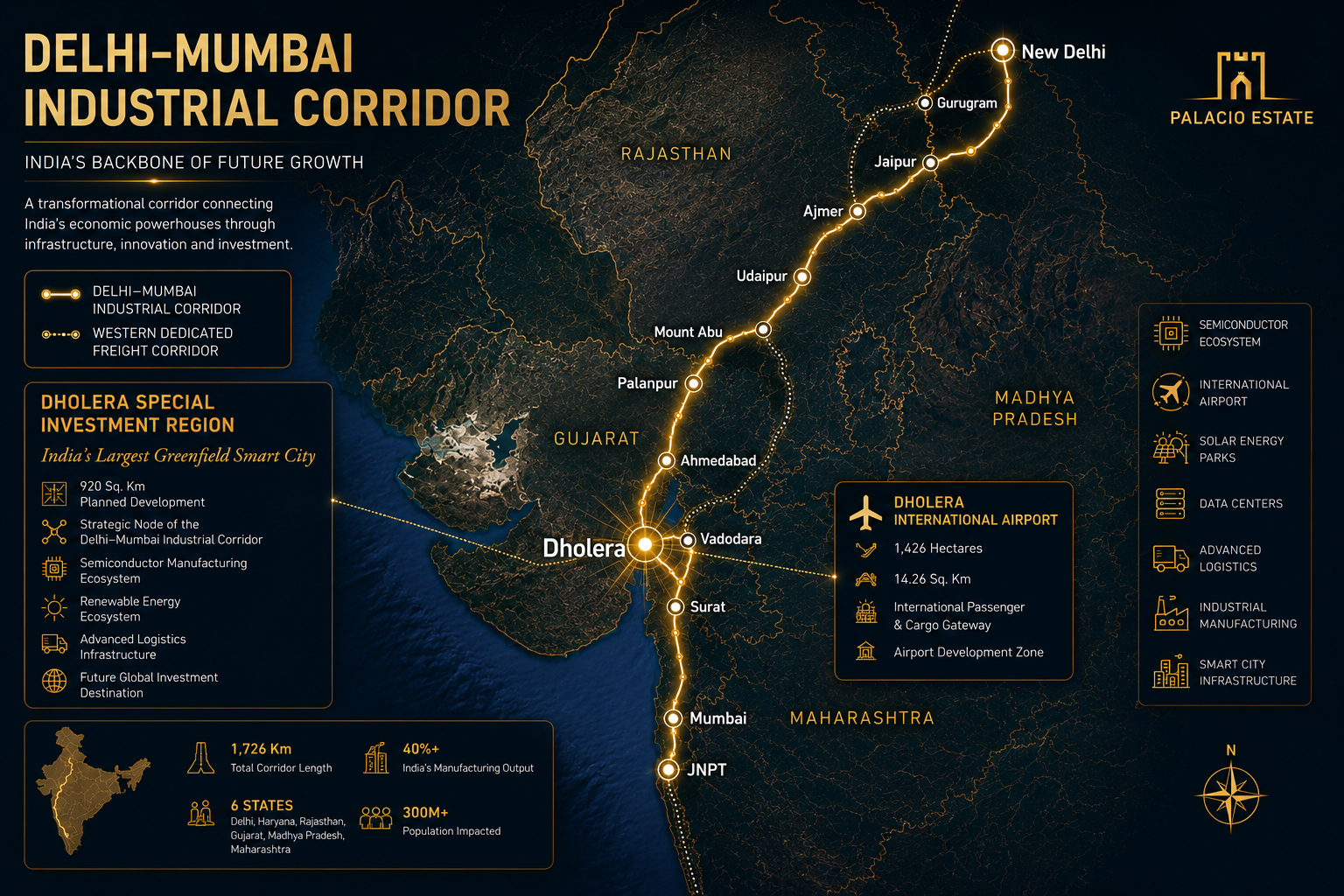
Delhi-Mumbai Industrial Corridor — India's Flagship Infrastructure Arc. Source: DMIDC, Ministry of Commerce & Industry.
The Delhi-Mumbai Industrial Corridor (DMIC) is India's most ambitious industrial infrastructure program. It is a bilateral agreement between India and Japan, signed in December 2006, with DMICDC (Delhi Mumbai Industrial Corridor Development Corporation) established in 2008 as the Special Purpose Vehicle to implement it. This is not a private real estate project. It is a national priority backed by two governments.
The corridor is aligned with the 1,504-kilometer Western Dedicated Freight Corridor, running from Dadri in Uttar Pradesh to JNPT (Jawaharlal Nehru Port Trust) in Mumbai. The freight corridor is a heavy-haul, high-speed cargo railway that bypasses the congested passenger network, reducing transit from days to under 24 hours. The DMIC has a 150-kilometer influence zone on both sides of this railway, covering a total influence area of 436,486 square kilometers, approximately 14% of India's total land area.
The scale is difficult to comprehend. The DMIC influence zone spans six states: Uttar Pradesh, Haryana, Rajasthan, Madhya Pradesh, Gujarat, and Maharashtra, plus the National Capital Region. It covers 89 districts, is home to 231 million people, and contributes 59% of India's GDP and 66% of its industrial output. The projected capital outlay is USD 90 to 100 billion. This is not a project. It is an economic transformation of half the country.
The DMIC is built on a bilateral equity structure: Japan holds 49%, Indian government entities hold 51%. This is not a loan arrangement where one country lends money and the other spends it. This is a partnership where both sides have skin in the game.
JICA (Japan International Cooperation Agency) committed USD 4.5 billion via STEP (Special Terms for Economic Partnership) loans. The terms are concessionary: 0.1% interest rate, 40-year repayment period, and a 10-year moratorium. These terms only come from government-to-government agreements, not commercial lending. A commercial loan at market rates would cost 8-12% interest with 10-15 year repayment. The JICA terms reduce the cost of infrastructure by billions of dollars over the life of the loans.
More than 114 Japanese firms have committed to establishing operations in the Industrial Townships along the corridor. Japanese companies see the DMIC as a way to access India's domestic market while also using India as a manufacturing base for exports to Africa, the Middle East, and Southeast Asia. The combination of Indian labor costs, Japanese technology, and government-backed infrastructure creates a competitive manufacturing environment.
The DMIC includes 8 major industrial nodes, each designed to serve a specific economic function:
| Node | State | Focus |
|---|---|---|
| Noida-Ghaziabad | Uttar Pradesh | IT, electronics, pharmaceuticals |
| Manesar-Bawal | Haryana | Automotive, manufacturing |
| Khushkhera-Bhiwadi | Rajasthan | Heavy industry, logistics |
| Pithampur-Dhar-Mhow | Madhya Pradesh | Defense, automotive components |
| Aurangabad-Bidkin | Maharashtra | Automotive, textiles |
| Panvel-Indapur | Maharashtra | Port-led industrialization |
| Dholera | Gujarat | Semiconductor, aerospace, data centers, solar |
| JNPT | Maharashtra | Port, logistics, container handling |
Dholera was selected as one of the 8 DMIC nodes because of three specific advantages: coastal location, port access, and availability of large tracts of undeveloped land. Those three factors, coast, port, open land, are exactly what make a logistics and industrial hub viable.
The Gulf of Khambhat provides natural deep-water access. Bhavnagar Port is being modernized with a ₹4,500 crore upgrade计划, including the world's first CNG terminal. The Ahmedabad-Dholera Expressway (inaugurated March 2026) provides road connectivity in 55 minutes. The Western Dedicated Freight Corridor will provide rail connectivity for heavy cargo. The combination of sea, road, rail, and air access makes Dholera the most multimodal node on the entire DMIC corridor.
The land availability is equally important. Most Indian industrial locations are constrained by land acquisition issues. Dholera has 920 sq km of designated SIR area with a land pooling model that avoids compulsory acquisition. Companies can get large plots of fully serviced industrial land without the years-long acquisition battles that plague other locations.
The Western DFC is the backbone of the DMIC. It is a heavy-haul, high-speed cargo railway that runs parallel to the DMIC corridor. The DFC bypasses the congested Indian passenger rail network, allowing freight trains to operate at speeds of up to 100 km/h with 15-tonne axle loads. Transit times drop from days to under 24 hours.
The DFC is being built by DFCCIL (Dedicated Freight Corridor Corporation of India Limited), a special purpose vehicle of the Indian government. The Western DFC covers 1,504 km from Dadri to JNPT. When fully operational, it will handle the bulk of freight movement between northern India and the western ports, including Kandla, Mundra, Pipavav, and JNPT. Dholera's proximity to this corridor means its industries can access raw materials and ship finished goods at costs competitive with any location in India.
The DMIC framework gives Dholera sovereign backing, not just state government support. When two national governments commit billions of dollars to a corridor, the infrastructure gets built. The roads get completed. The ports get expanded. The power plants come online. This is fundamentally different from a private developer promising amenities on a brochure.
The DMIC is the reason Dholera has a functioning expressway, an under-construction airport, and a dedicated freight corridor within reach. These are not speculative features. They are government-funded infrastructure with committed timelines and dedicated budgets. The Japanese government has committed USD 4.5 billion in concessional loans specifically for DMIC projects. That money is earmarked, disbursed in phases, and tied to project milestones. It does not disappear when market conditions change.
For investors, the DMIC reduces risk in three ways. First, the infrastructure is government-funded and will be built regardless of market conditions. Second, the Japan partnership brings international standards of governance and transparency. Third, the 114+ Japanese firms already committed to the corridor create a critical mass of industrial activity that attracts suppliers, service providers, and workers. Dholera is not a bet on one developer or one government. It is a bet on a bilateral economic partnership between the world's third-largest economy and the world's most populous country.
← Back to Connectivity