₹4,500 crore museum complex. 400 acres. 22,000 jobs. 4,500 years of maritime history.
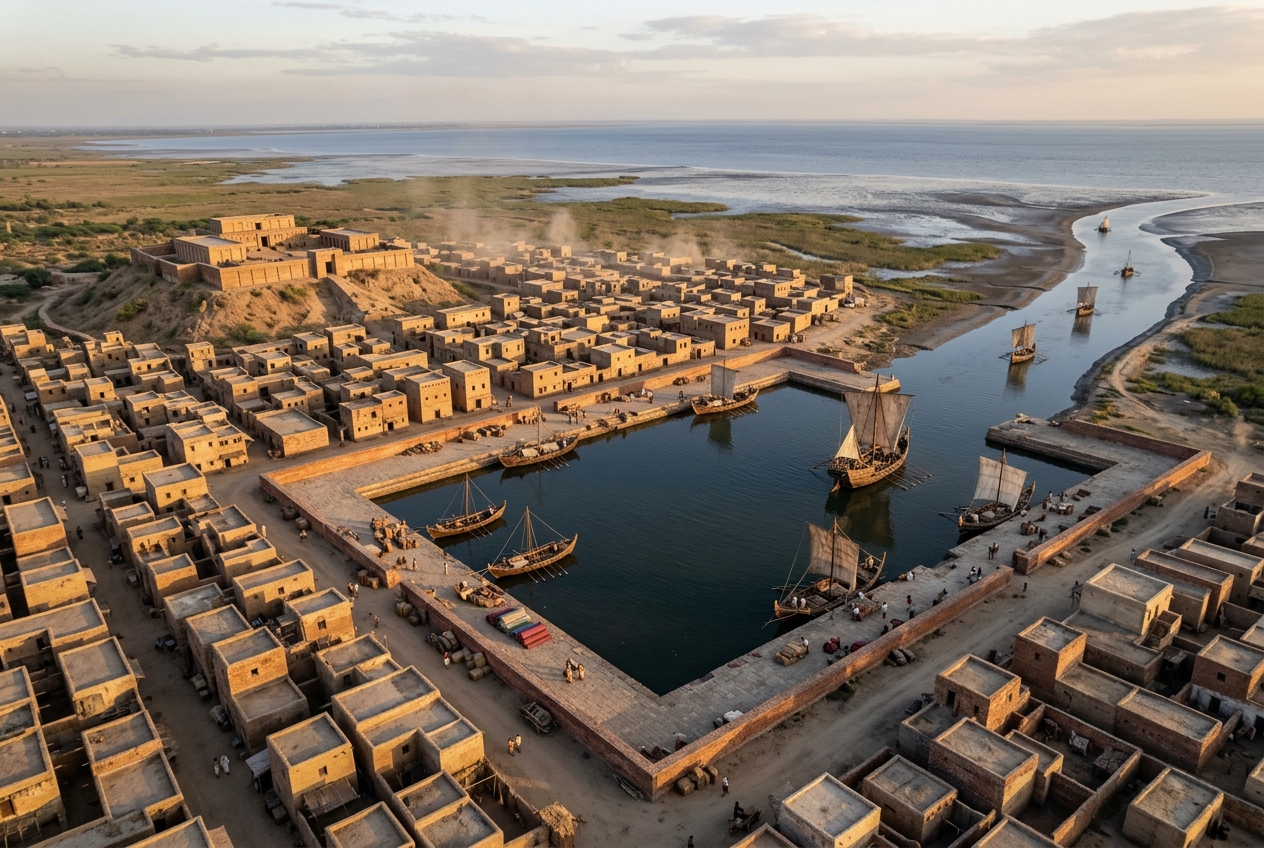
Lothal is not just an archaeological site. It is the birthplace of organized maritime trade. Excavated between 1955 and 1960 by Dr. S.R. Rao of the Archaeological Survey of India, this small settlement in Gujarat's Saurashtra region turned out to be one of the most important discoveries in Indian history.
The star find was the dockyard. At 218 meters long and 37 meters wide, it was engineered to hold 20 to 30 vessels at once. Built around 2400 BCE, it predates every known dry dock or tidal dock in the world by more than a thousand years. The Harappan engineers who designed it understood tidal patterns, water flow, and construction techniques that would not appear in Europe until the medieval period.
The settlement covered 7 hectares, split between a raised citadel and a lower town. Trade goods found here include carnelian beads from Gujarat, copper tools from Rajasthan, and seals matching those found in Mesopotamia. The evidence points to regular trade routes connecting Lothal to Oman, Bahrain, and the Tigris-Euphrates region. These were not occasional voyages. They were sustained commercial networks spanning thousands of kilometers, and they ran through this port for centuries.
The civilization declined around 1900 BCE, likely due to repeated flooding from the Sabarmati River. But the technology and knowledge it represented did not disappear. It evolved. Maritime traditions in Gujarat continued unbroken for thousands of years, leading to the seafaring kingdoms, spice trade routes, and shipbuilding centers that defined western India's economy through the medieval and colonial periods.
The Indian government announced the National Maritime Heritage Complex (NMHC) to give Lothal the recognition it deserves. The numbers are large: ₹4,500 crore (roughly US$520 million) in total investment, spread across a 400-acre campus. That breaks down to 375 acres for the public museum complex and 25 acres for staff residential quarters.
The project sits under the Ministry of Ports, Shipping and Waterways. India has signed a cooperation agreement with Portugal, which will contribute expertise and content for the maritime gallery. When complete, the complex is expected to generate 22,000 jobs, with 15,000 direct positions in the museum, hospitality, and support sectors, plus another 7,000 indirect jobs in local services, transport, and construction.
The centerpiece of the campus is a 77-meter lighthouse, which will serve as both an observation tower and a symbolic structure visible from across the region. Around it, the complex will include a parking facility for 1,500 cars (the Bagicha Complex), outdoor exhibit spaces for naval artifacts, a jetty walkway, and a recreated Harappan settlement that lets visitors experience what daily life looked like 4,500 years ago.
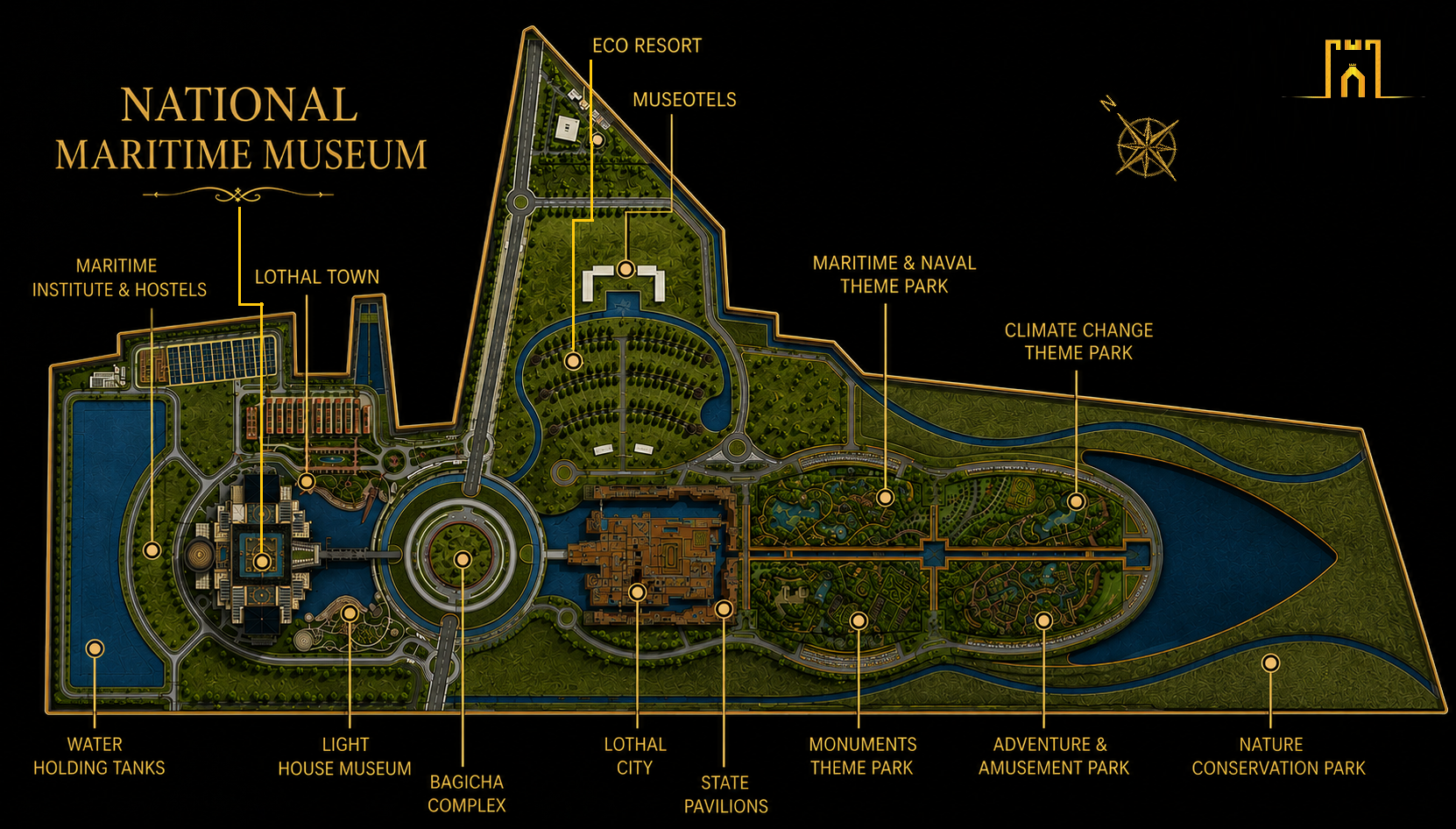
National Maritime Heritage Complex — Campus Layout. Click to enlarge.
The museum will house 14 themed galleries, each covering a different era or aspect of India's maritime story. Here is the full list:
These galleries are not a random collection. They trace a continuous thread from 3700 BCE to the present day, connecting Lothal's ancient dockyard to modern Indian naval power. The Harappan gallery will feature original artifacts from the excavation, including seals, tools, and beadwork. The naval gallery will display decommissioned warships and aircraft, including INS Nishank, a Sea Harrier jet, and a UH3 helicopter, all positioned outdoors as walk-through exhibits.
Construction is underway. Tata Projects won the EPC contract for Phase 1A, which is the first tranche of the complex and the one closest to completion. The target date is July 2026.
Phase 1A includes the core museum building, six of the fourteen galleries (galleries 1 through 4, plus the naval and special exhibition spaces), the outdoor naval artifact displays, a replica Harappan township, an aquatic gallery, and the jetty walkway connecting the campus to the water. This is the phase that will open to the public first and set the tone for the entire project.
Phase 1B follows with the remaining eight galleries, the lighthouse district, the Bagicha parking complex, food halls, and a medical center. Phase 2, structured as a public-private partnership, will add coastal state pavilions, hospitality infrastructure, "museuotels" (a new category combining museum and hotel), a fully recreated Lothal city, and a Maritime Research Institute.
In June 2023, the government established the Lothal Development Area (LADA) to manage the region around the museum. It covers 196.88 square kilometers and includes eight villages. The draft development plan runs to 2047, giving developers and investors a clear timeline.
| Village | Population | Area (ha) | Investment Angle |
|---|---|---|---|
| Koth | 10,439 | 4,636.62 | Strong commercial potential |
| Saragvala | 2,972 | 2,703.42 | Highest potential (NMHC proximity) |
| Arnej | 1,592 | 1,103.34 | Residential zoning |
| Gundi | 3,237 | - | Ancillary tourism |
| Samani | 621 | - | Land banking |
| Bholad | 1,893 | - | Residential zoning |
| Jawaraj | 2,453 | - | Transport and logistics |
| Bhurkhi | 1,836 | - | Transit-oriented development (railway station) |
LADA allows FSI up to 1.5 for residential, 2.0 for retail and commercial, and 2.5 for manufacturing and industrial use. These numbers are generous by Gujarat standards and reflect the government's intent to attract serious development around the museum.
Lothal sits 85 kilometers from Ahmedabad via the fully functional Ahmedabad-Dholera Expressway (NH-751). The drive takes about 55 minutes from central Ahmedabad. The expressway connects directly to the Lothal area, making it the fastest and most convenient route for visitors. The current closest railway station is Lothal-Bhurkhi, about 6 kilometers from the museum site.
The expressway has made Lothal a practical day-trip from Ahmedabad. You can leave in the morning, spend several hours at the museum and heritage site, and return the same day without exhaustion. This was not possible before the expressway when the journey took 2.5 to 3 hours each way on congested state highways.
The bigger story is the Ahmedabad-Dholera Semi High-Speed Rail. This 134-kilometer corridor will operate at 200 kmph, cutting travel time between Ahmedabad and the Dholera/Lothal region to under 45 minutes. The project budget is approximately ₹6,000 crore, and it is designed to serve both Dholera's industrial zones and Lothal's cultural campus. Once operational, it turns Lothal from a day-trip destination into a regular commuter corridor, which changes the entire economic equation for real estate in the area.
Together, the expressway and future rail make Lothal one of the most accessible heritage sites in India, not just in Gujarat.
The numbers paint a clear picture. Commercial property near the museum corridor is projected to deliver 12% annual ROI over a five-year horizon, driven by hospitality demand, retail footfall from museum visitors, and the services sector growing around 22,000 new jobs. Residential land in the LADA villages is expected to appreciate up to 40% within three-year cycles, with the highest gains in Saragvala (closest to the museum) and Bhurkhi (anchored by the future railway station).
By 2030, Phase 1 will be complete and the semi-high-speed rail will be operational. That is the inflection point. By 2035, Phase 2 matures, international leisure travelers arrive, and the Maritime Research Institute establishes Lothal as an academic destination. By 2040, the area transitions from an emerging market to a mature cultural corridor.
The relationship between Dholera and Lothal is complementary, not competitive. Dholera provides the industrial engine: manufacturing, data centers, semiconductors, logistics. Lothal provides the cultural anchor: tourism, hospitality, education, recreation. They are connected by the same rail and expressway corridor, and together they form a complete ecosystem that is rare in Indian real estate. One generates the jobs and the daytime population. The other provides the reason to stay, visit, and spend. That combination is what makes the broader Dholera-Lothal region stand out from pure industrial zones or pure tourism towns.
Lothal's story began 4,400 years ago. Explore the ancient port city that started it all.
Explore ancient Lothal history →