The world's oldest tidal dockyard. A Harappan port that traded with Mesopotamia and Egypt. 4,400 years of maritime legacy on the same coastline where Dholera stands today.
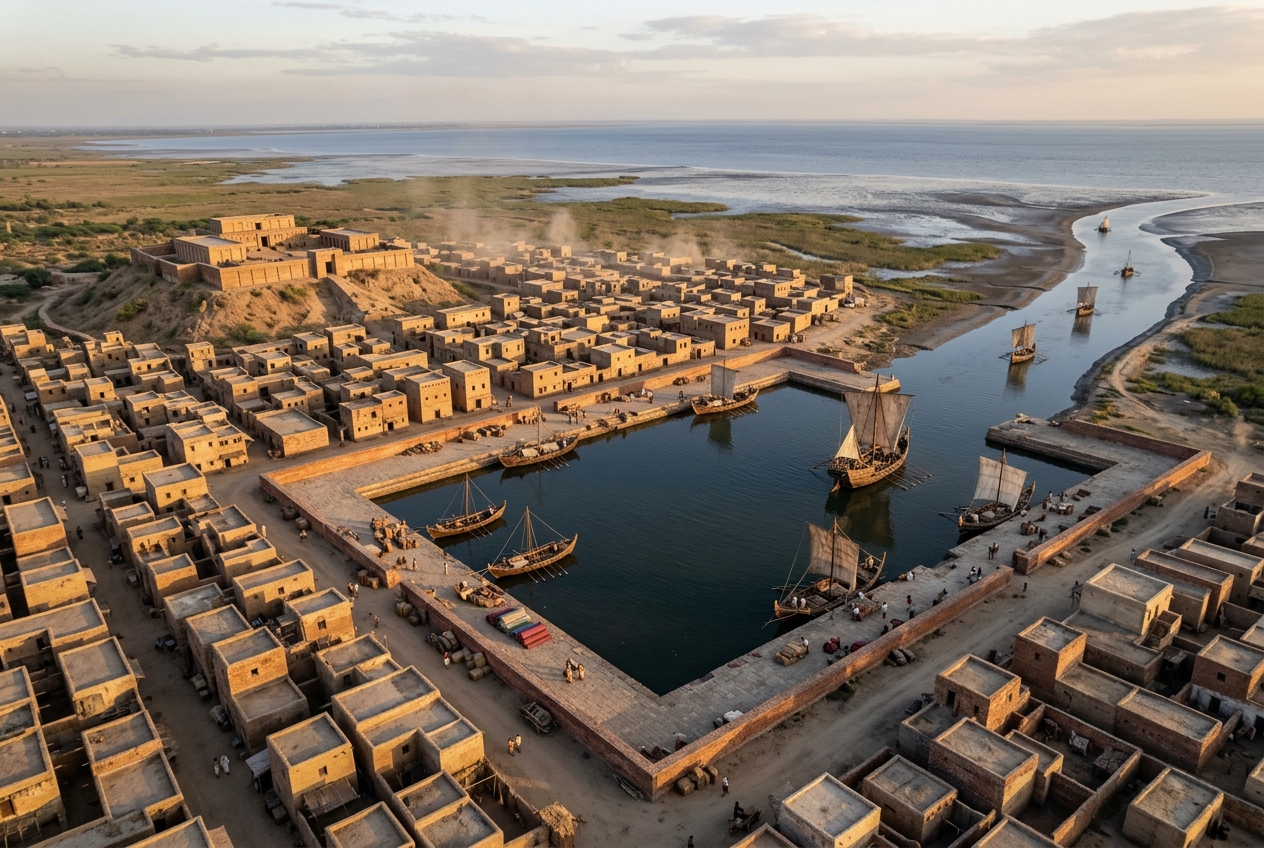
Lothal was a Harappan port city in Gujarat, built around 2400 BCE. It was not a small settlement. It was a full-scale trading hub with a dockyard, warehouses, a bead-making industry, and an advanced drainage system. When S.R. Rao excavated it in 1954, he found evidence of maritime trade routes connecting this part of Gujarat to Mesopotamia, Egypt, and Persia.
The dock was massive: 218 meters long and 37 meters wide. It was connected to an ancient course of the Sabarmati River, allowing ships to enter from the Gulf of Khambhat. This was not an accidental harbor. The Harappans understood tidal patterns and built infrastructure to work with them. The dock was designed to remain navigable even during low tides, a feat of hydraulic engineering that would not be replicated in this region for millennia.
Lothal's location was strategic. It sat at the head of the Gulf of Khambhat, where the Sabarmati River met the sea. This gave it access to both maritime trade routes and inland river networks. Ships could reach the Persian Gulf from here. River boats could travel inland to the Harappan heartland in Rajasthan and Sindh. It was a transshipment point, a place where goods moved between sea and river transport.
The bead-making workshop at Lothal produced carnelian beads that have been found in archaeological sites as far as Ur in Mesopotamia. These were not cheap goods. Carnelian beads required specialized heating and shaping techniques, and the Lothal artisans were among the best in the ancient world. The process involved heating raw carnelian to over 300 degrees Celsius to enhance its color, then drilling holes using a bow drill with agate bits. A single bead could take days to complete.
Beyond beads, Lothal exported ivory, copper, semi-precious stones, and shell objects. It imported tin, raw materials, and finished goods from the Persian Gulf. The warehouse system was organized by trade goods, suggesting a sophisticated commercial operation. Archaeologists found seals with inscriptions, indicating a standardized system of weights and measures used across the trade network. This was not barter between villages. This was international maritime commerce, 4,400 years ago.
The bead trade was particularly significant. Carnelians from Lothal have been found at Ur, Kish, and other Mesopotamian cities, dating to the Akkadian period (2350-2150 BCE). The trade route ran from Lothal through the Gulf of Khambhat, along the coast of Oman (then called Magan), up the Persian Gulf to Ur and Kish. Ships carried carnelian beads, shell, ivory, and copper in exchange for tin, lapis lazuli, and silver. This was a two-way trade that lasted centuries.
The Lothal dockyard was the world's oldest known tidal dock. At 218 meters by 37 meters, it was large enough to berth ships of significant size. The dock was connected to a channel that led to the Sabarmati River, allowing water to flow in and out with the tides. The Harappans built a system of sluice gates that could control water levels, keeping the dock navigable even during low tide.
The engineering required to build this was substantial. The Harappans had to understand tidal patterns, water flow, and sediment transport. They had to build structures that could withstand the Gulf of Khambhat's extreme tidal swings, which can exceed 11 meters. The dock walls were made of burnt brick, bonded with gypsum mortar. The construction quality was such that the dock remained functional for centuries.
This is not speculative history. The Archaeological Survey of India excavated the site extensively. The dock's dimensions, construction materials, and hydraulic features are well-documented in peer-reviewed archaeological literature. S.R. Rao's excavations from 1954 to 1960 established Lothal as the oldest known tidal dock in the world, a distinction it still holds.
Lothal was not just a dock. It was a planned city with a grid layout, streets oriented north-south and east-west. The city had an advanced drainage system, with covered drains running beneath the streets, connected to soak pits. Every house had a bathing platform and a toilet connected to the drainage system. This level of urban planning was not seen again in this region until the British built Ahmedabad's sewage system in the 19th century.
The city had a warehouse district near the dock, where goods were stored before export or after import. The bead-making workshop was in a separate industrial area. Residential areas were organized by social status, with larger houses for merchants and smaller ones for workers. The city was surrounded by a fortification wall with a moat, suggesting that defense was also a consideration.
Lothal also had a rice-husking area, a copper-smithy, and evidence of cotton cultivation. The Harappans here were not just traders. They were manufacturers, farmers, and engineers. The city was a self-sustaining economic unit that also happened to be a major international port.
The Gulf of Khambhat coastline where Lothal was built is the same coastline where Dholera is being developed today. The Harappans chose this location because of its strategic position: a natural harbor, access to inland trade routes, and proximity to raw materials. Those same factors apply to Dholera. The coastline has not changed. The strategic advantage has not changed. What has changed is the scale of infrastructure being built to exploit that advantage.
When investors look at Dholera, they are not looking at an untested location. They are looking at a coastline with 4,400 years of continuous maritime trade history. Lothal proves that this region can support large-scale commercial activity. The Harappans did it with bronze-age tools. The infrastructure being built today, the expressway, the airport, the port modernization, is orders of magnitude more capable.
The parallels are striking. Lothal was a greenfield port city built on undeveloped land. Dholera is a greenfield smart city built on the same type of land. Lothal attracted international trade from Mesopotamia and Egypt. Dholera is attracting international investment from Japan, South Korea, and the United States. Lothal had advanced infrastructure for its time: docks, drainage, warehouses. Dholera has advanced infrastructure for its time: underground utility corridors, smart grid power, zero liquid discharge. The scale is different. The ambition is the same.
Lothal's legacy continues today. The ₹4,500 crore National Maritime Heritage Complex is being built 6 km from the ancient dockyard.
Read about the modern NMHC development →