Three horizons. From infrastructure delivery to global smart city.
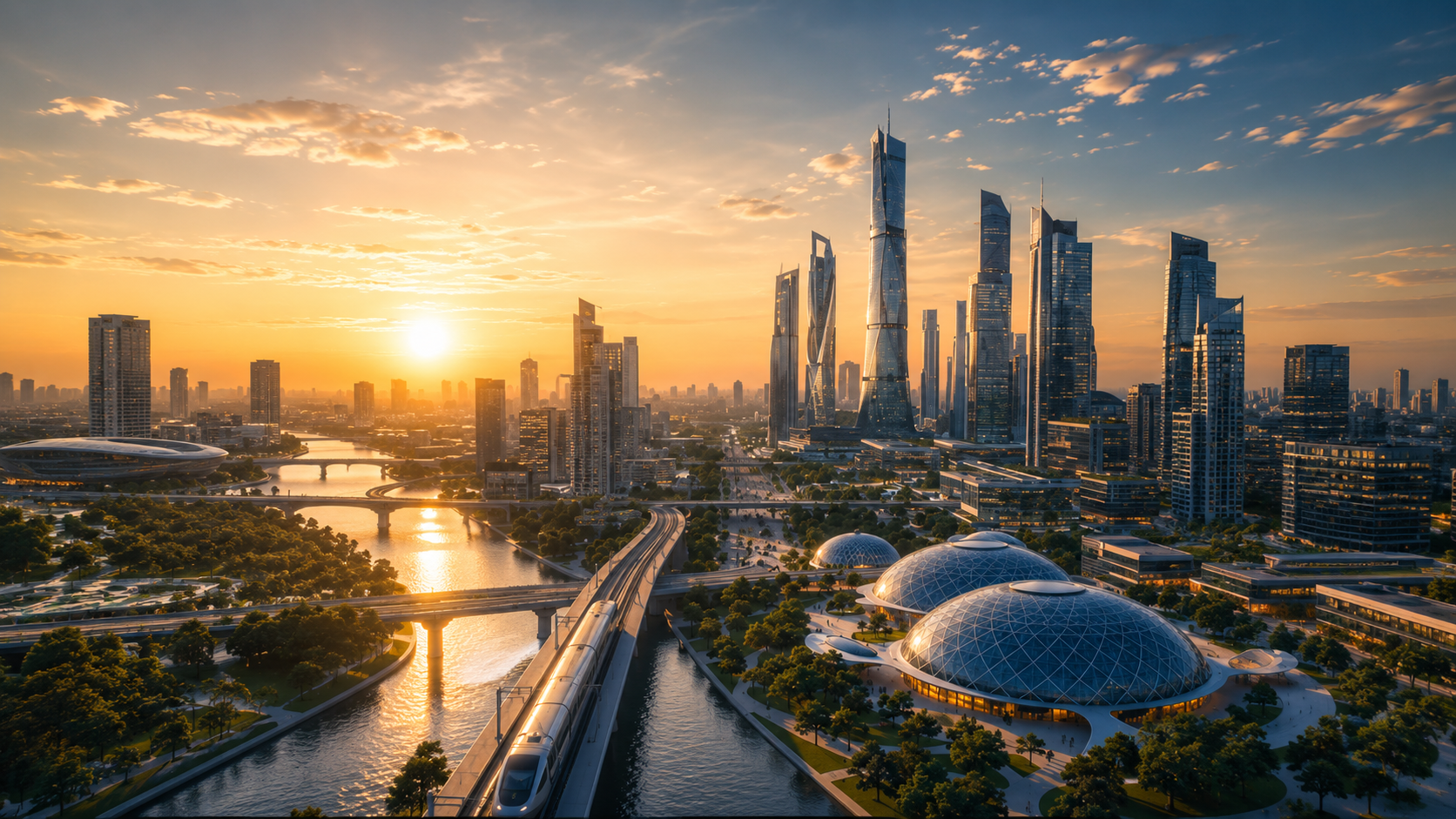
Phase 1 wrapped up in late 2025. The 22.5 sq km activation area inside TP2 hit 95% completion. Primary arterials are 75 meters wide. Underground utility ducts carry power and ICT lines. The Narmada River water pipeline is operational. The ABCD Building houses the Integrated Command and Control Center. This is the foundation. Phase 2 is where Dholera stops being a construction site and starts functioning as an industrial city.
Between now and 2030, the focus shifts from laying pipes and roads to filling them with industry, jobs, and residents. The activation area needs tenants. TP2 has industrial plots ready for allotment. TP3 and TP4 are developing along the HAC corridor for warehousing and logistics. TP5, at 75 sq km, is designated for the IT Park and Knowledge Zone, but it remains in early-stage development. TP6, covering 67 sq km, sits on a 10 to 15 year timeline. The immediate priority is simple: get factories running, get workers housed, and get the airport built.
Phase 2 also means scaling the industrial anchors that will define Dholera's identity for decades. A city without a dominant industry is just a suburb. Dholera is betting on semiconductors, display manufacturing, and electric vehicles. The Tata investment alone is large enough to shape the entire region's economy.
The Tata Semiconductor facility is the single largest investment in Dholera's history. The project is valued at ₹910 billion, roughly $11 billion USD. It will produce chips on 110nm to 28nm process nodes. At full capacity, the plant will handle 50,000 wafer starts per month (WSPM). That makes it one of the largest semiconductor fabrication plants in South Asia.
But semiconductors do not exist in isolation. Tata is also setting up display manufacturing in partnership with PSMC and Himax, focused on display driver ICs (DDICs). This is a deliberate vertical integration play. Chips go into displays, displays go into devices, and the entire supply chain sits within a 50 km radius. The EV cluster adds another layer. Tata Motors and MG Motors are establishing manufacturing and assembly operations nearby, creating demand for the chips and displays produced on-site.
Defense and aerospace parks are scheduled for construction starting in 2027. These parks will serve companies that need proximity to both the semiconductor supply chain and Gujarat's coastal logistics routes. The combination of chips, displays, EVs, and defense manufacturing creates an industrial ecosystem with real depth. It is not a single factory town. It is a network of related industries that feed each other's growth.
The job multiplier effect is significant. A semiconductor fab does not just employ engineers. It needs facility managers, logistics coordinators, food service workers, security staff, maintenance crews, and retail operators. For every direct manufacturing job, the broader economy creates between 3 and 5 additional positions. When the Tata plant reaches full production, the ripple effect will support tens of thousands of secondary jobs across Dholera.
By 2030, Dholera should look and feel like a functioning city. The airport enters Phase 1 operations with a single 4,000-meter runway, capable of handling 1.2 to 3.0 million passengers per year. The ultimate plan calls for dual runways and capacity for 50 million passengers annually, but Phase 1 is about proving the concept and connecting Dholera to domestic and select international routes.
The Ahmedabad-Dholera Expressway, already under construction, will complete by 2026 and cut travel time between the two cities to roughly one hour. This expressway is not just a road. It is the lifeline that makes Dholera accessible to Ahmedabad's existing workforce, universities, and supply chains. Without it, Dholera is isolated. With it, Dholera becomes a natural extension of Gujarat's largest metro.
The monorail system, spanning 90 to 100 km, begins construction in 2028. It will connect industrial zones, residential areas, the airport, and the commercial district. By 2030, the first segments should be operational, moving workers between housing clusters and factory floors without cars. This is not a vanity project. It is a practical solution to a practical problem: how do you move 200,000+ workers daily in a city that has no legacy road network to rely on?
The solar park, covering over 11,000 hectares, targets 5,000 MW of installed capacity by 2030. This makes Dholera one of the largest solar energy zones in India. Cheap, clean power is not just an environmental goal. It is a competitive advantage for energy-intensive industries like semiconductor manufacturing, which consumes enormous amounts of electricity. Producing chips next to a massive solar installation means lower operating costs and a smaller carbon footprint than competitors in other regions.
Airport Phase 1 operational. Expressway complete. Monorail first segments running. Solar park at 5,000 MW. Tata fab producing at scale. TP2 fully activated. 600,000 residents.
The jump from 2030 to 2040 is about shifting from construction to operation. By 2040, Dholera aims to be a zero-carbon, circular-economy city. This is not a marketing slogan. It is an engineering target with specific metrics and enforcement mechanisms.
Zero Liquid Discharge (ZLD) is already mandated for industrial operations in the DSIR master plan. Every factory must treat and recycle its own wastewater. No industrial effluent enters the natural water system. By 2040, this principle extends to residential and commercial zones as well. Stormwater harvesting, greywater recycling, and desalination capacity from the Gulf of Khambhat form a closed-loop water system. The city should produce more clean water than it consumes.
Waste-to-energy facilities handle the city's solid waste, converting it into electricity and reducing landfill dependence to near zero. The IoT network, already partially operational in Phase 1, expands to cover every district. Traffic management, air quality monitoring, stormwater flow control, and building telemetry all feed into the Integrated Command and Control Center. The city essentially runs on data. Problems get identified and resolved before residents notice them.
The 340 sq km Coastal Regulation Zone (CRZ) remains protected. This is not optional. The CRZ is home to critical ecosystems, including the Gulf of Khambhat's marine biodiversity and the flamingo habitats at the salt flats. Keeping this land off-limits to development is both an environmental obligation and a quality-of-life asset. Residents of a zero-carbon city expect clean air, open spaces, and access to nature. The CRZ delivers that.
Green canopy targets reach 30% coverage across the developed zones. Parks sit within 400 meters of every neighborhood and within 800 meters of every community center. These are not afterthoughts. They are part of the original Halcrow master plan, designed into the city's layout from the beginning. By 2040, they should be mature, providing shade, biodiversity corridors, and recreational space for a population approaching one million.
Zero-carbon operations. Full ZLD across all zones. Waste-to-energy online. IoT covers every district. 340 sq km CRZ protected. 30% green canopy. Population approaching 1 million.
By 2050, Dholera's ambition is to operate on the same level as Singapore, Tokyo, or Shanghai. That comparison is intentional. The master plan does not aim for "best city in Gujarat" or even "best city in India." It aims for global relevance in the semiconductor, clean energy, and advanced manufacturing sectors.
The semiconductor ecosystem alone could generate up to $1 trillion in output when you include the full supply chain: raw materials, fabrication, packaging, testing, equipment manufacturing, and the downstream industries that consume chips. This is a 25-year trajectory, not a 5-year plan. But the foundation is being poured right now, and the early anchors (Tata, PSMC, the defense parks) give the trajectory credible momentum.
At 2 million residents, Dholera will be a mid-sized city by Indian standards but a major economic hub by global standards. The key difference between Dholera and other cities of similar size is infrastructure quality. Most cities this size in India are struggling with water supply, traffic congestion, waste management, and air quality. Dholera's planned infrastructure, built from scratch to current specifications, should handle 2 million residents without the retrofitting crises that plague older cities.
The airport expands to dual runways with 50 million passenger capacity. The monorail network reaches full build-out across all industrial and residential zones. The solar park grows beyond its initial 5,000 MW target. Data centers, attracted by cheap power and low latency connections to Mumbai and Ahmedabad, establish Dholera as a secondary data hub for western India. Education institutions, drawn by the research ecosystem around semiconductors and clean energy, create a talent pipeline that feeds the city's industries for decades.
The $1 trillion ecosystem is not just semiconductor revenue. It includes the EV manufacturing output, the data center economy, the solar energy exports, the aerospace and defense contracts, and the services sector that grows around all of these. When you combine manufacturing, energy, technology, and services in a single planned city with world-class infrastructure, the economic output scales faster than any single industry could achieve alone.
The population trajectory follows a predictable pattern for planned industrial cities. There is an initial slow phase while infrastructure is completed, a rapid acceleration phase as industries come online and create jobs, and a maturation phase as the city fills out its planned capacity.
| Year | Population | Jobs | Key Workers |
|---|---|---|---|
| 2026 | 96,000 | 76,000 | Engineers, construction crews, utility operators |
| 2032 | 450,000 - 600,000 | 250,000 - 350,000 | Industrial workers, logistics staff, retail operators |
| 2042 | 1.0 - 2.0 million | 800,000 - 827,000 | Families, researchers, corporate employees |
In 2026, the population sits at roughly 96,000. These are the pioneers: construction workers finishing Phase 2, utility operators running the water and power systems, engineers commissioning the Tata fab, and early commercial tenants setting up shops and services. The job count is around 76,000, with the majority in construction and infrastructure.
By 2032, the jump to 450,000 to 600,000 residents reflects the semiconductor plant reaching full production, the airport opening, and the monorail becoming operational. Jobs expand to 250,000 to 350,000, with a growing share in manufacturing, logistics, and retail. This is the inflection point. The city stops being a construction zone and starts being a place where people live, work, and raise families.
The 2042 projection of 1 to 2 million residents comes with 800,000 to 827,000 jobs. The job multiplier is the key metric here. For every manufacturing position created, the broader economy generates 3 to 5 additional jobs in services, housing, education, healthcare, and retail. A semiconductor fab with 10,000 direct employees can support 30,000 to 50,000 total positions in the surrounding area. This multiplier effect is what transforms a factory town into a self-sustaining metropolis.
The population growth also drives land value appreciation. Residential plots in TP1 and TP2, currently priced at ₹14,000 to ₹19,000 per square yard, will see steady increases as demand for housing grows. Commercial plots in the CBD, at ₹18,000 to ₹28,000 per square yard, will appreciate faster once the airport and monorail prove the city's connectivity claims. The early investors who buy at today's prices are positioning for a 10 to 20 year growth cycle, not a quick flip.
Dholera's vision is not a promise. It is a plan with specific milestones, measurable targets, and government backing through the DSIRDA. The question is not whether Dholera will grow. The question is how fast, and whether you are positioned to benefit when it does.
← Back to Vision