Every 500 meters. Harappan symbols on concrete. Gravity does the work.
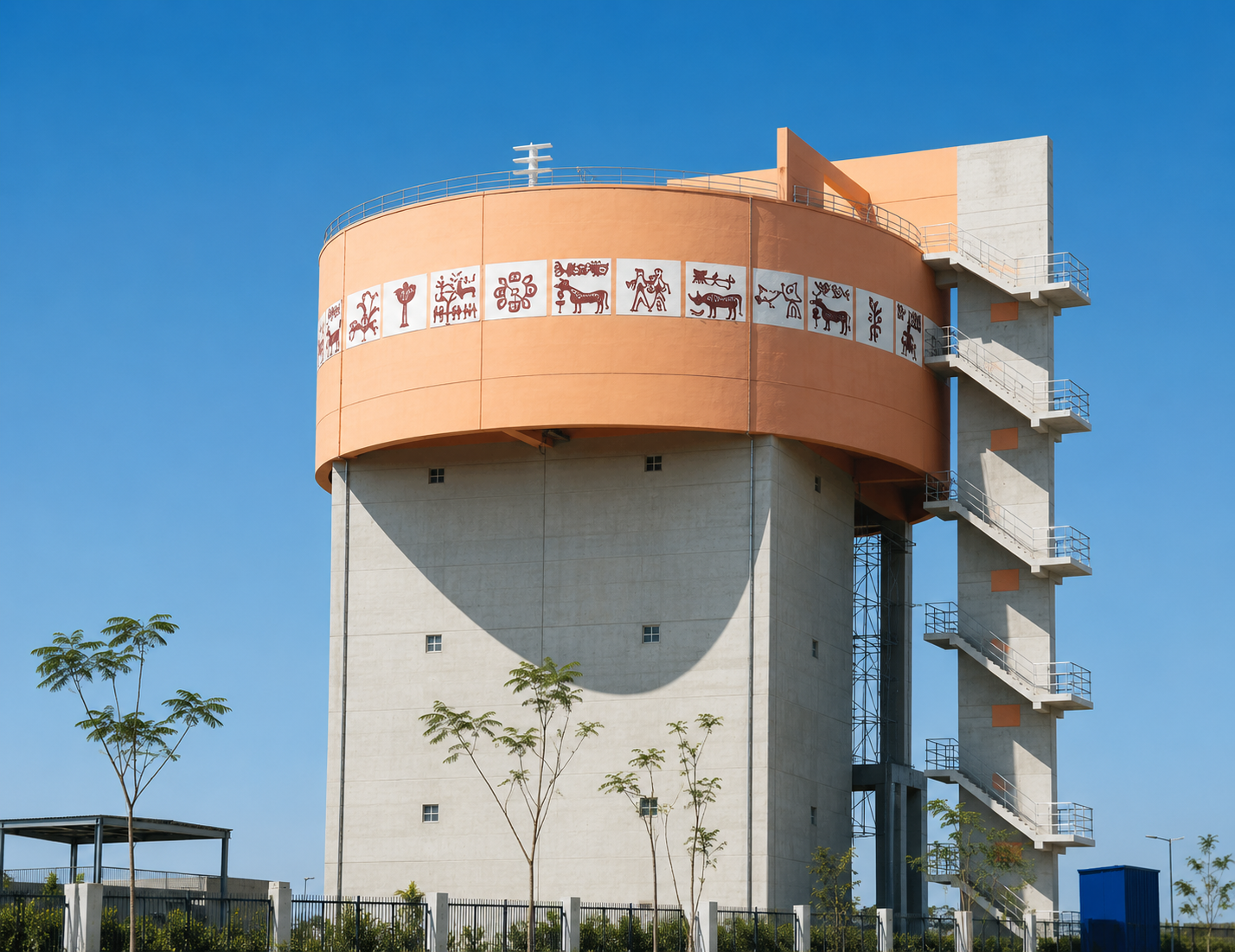
Drive through the Activation Area of Dholera SIR and you will see them. Cylindrical concrete towers, painted terracotta orange, standing at regular intervals like sentinels. Each one carries a band of red pictographs near the top — figures of animals, geometric patterns, human forms. They look like they belong in a museum. They are water tanks.
These elevated storage reservoirs are spaced exactly 500 meters apart across the smart city. That spacing is not decorative. It is hydraulic engineering. At 500 meters, each tank covers a defined service zone where water pressure remains consistent whether you are at the first building or the last. No resident gets weak flow. No factory gets insufficient pressure. The system equalizes distribution by design, not by accident.
The water does not arrive at your tap by magic. It travels a specific path from source to consumption, and the elevated tanks are the critical middle step that makes consistent pressure possible.
A 50 MLD Water Treatment Plant processes raw water from the source. The plant uses conventional treatment — coagulation, flocculation, sedimentation, filtration, and disinfection. The treated water meets Bureau of Indian Standards for potable use. The plant is built to scale to 150 MLD as the city's population grows.
Treated water flows into a Master Balancing Reservoir, a large ground-level storage that acts as the system's buffer. It absorbs fluctuations between treatment output and city demand. During low-demand hours, the reservoir fills. During peak hours, it supplements supply. This prevents pressure drops when thousands of taps open simultaneously.
From the balancing reservoir, pumps push water up into the elevated storage tanks. Each tank sits on a concrete staging structure, raising the water surface 15 to 20 meters above ground level. That height is what creates gravitational pressure. No pumps needed at the distribution stage — gravity does the work.
Water flows down from each elevated tank through underground pipelines to buildings, factories, and households in its 500-meter zone. The gravitational head ensures consistent pressure across the entire service area. When the tank level drops below a set point, SCADA sensors trigger the pumps to refill it. The system runs automatically.
The 500-meter spacing follows a principle called the "service radius." Every elevated tank has a maximum distance from which it can deliver water at acceptable pressure. Beyond that distance, friction losses in the pipes reduce flow to inadequate levels. At 500 meters, the Dholera system ensures that no point in the city is more than a 500-meter straight-line distance from a pressure source.
This matters for fire safety as much as daily convenience. Fire hydrants need minimum pressure to function. A building 800 meters from the nearest tank might have fine drinking pressure but insufficient fire suppression flow. The 500-meter grid eliminates that risk. Every building, every plot, every factory floor sits within the guaranteed pressure zone of at least one elevated tank.
The spacing also simplifies maintenance. When one tank needs cleaning or repair, its zone can be temporarily supplied by neighboring tanks through interconnecting pipelines. The 500-meter grid creates redundancy — no single point of failure can leave an area dry.
Here is what makes these tanks different from every other water infrastructure in India. Near the top of each tank, a decorative band wraps around the circumference. On that band, red pictographs are painted on white squares — figures of animals, human forms, geometric patterns, and motifs that mirror the seals found at Lothal.
Lothal sits just 80 kilometers from Dholera. The Harappan civilization that built the world's earliest known tidal dockyard also built sophisticated water management systems — covered drains, soak pits, and reservoirs. They understood water. They built for it. They planned around it.
Painting their symbols on Dholera's water tanks is not just aesthetic. It is a deliberate connection between the oldest known urban water civilization in this region and the newest. The Harappans managed water with baked bricks and gravity. Dholera manages it with concrete and SCADA. The principle is the same: plan the infrastructure, store the water at height, let gravity distribute it evenly.
If you live in Dholera, you will never deal with weak water pressure during morning hours. You will never hear neighbors complain that the third floor gets no water while the ground floor floods. The 500-meter elevated tank grid eliminates the pressure inequality that plagues every Indian city where water is pumped directly from ground-level sources.
For industrial users, this matters even more. Semiconductor fabs, data centers, and manufacturing plants need consistent water pressure for cooling systems, cleaning processes, and fire suppression. A pressure drop of even 10% can damage equipment or trigger shutdowns. Dholera's elevated tank system guarantees pressure within design specifications at all times.
For investors, the water infrastructure signals something important about the city's planning maturity. Most Indian smart cities talk about water. Dholera built the tanks, laid the pipes, and connected them to a SCADA network that monitors pressure, flow, and quality in real time. The infrastructure is not promised. It is operational.
The elevated tanks are one component of a complete water ecosystem. The system includes a sewage treatment plant that recycles grey water for non-potable uses, dual plumbing networks in buildings, zero-liquid-discharge requirements for industrial zones, and stormwater management through the canal network. The goal is to reduce freshwater dependence while ensuring unlimited potable supply.
Every drop is tracked. SCADA sensors at the treatment plant, in the balancing reservoir, at each elevated tank, and along the distribution network feed data back to the Smart Command Center. The ICCC dashboard shows real-time water levels, flow rates, pressure readings, and quality parameters. If a pipe bursts or a tank level drops unexpectedly, the system alerts operators within seconds.
See how the water network connects to the rest of Dholera's smart infrastructure.
Explore the Command Center →