From Narmada Canal to your tap. From your drain back to the factory floor. Every drop treated. Nothing wasted.
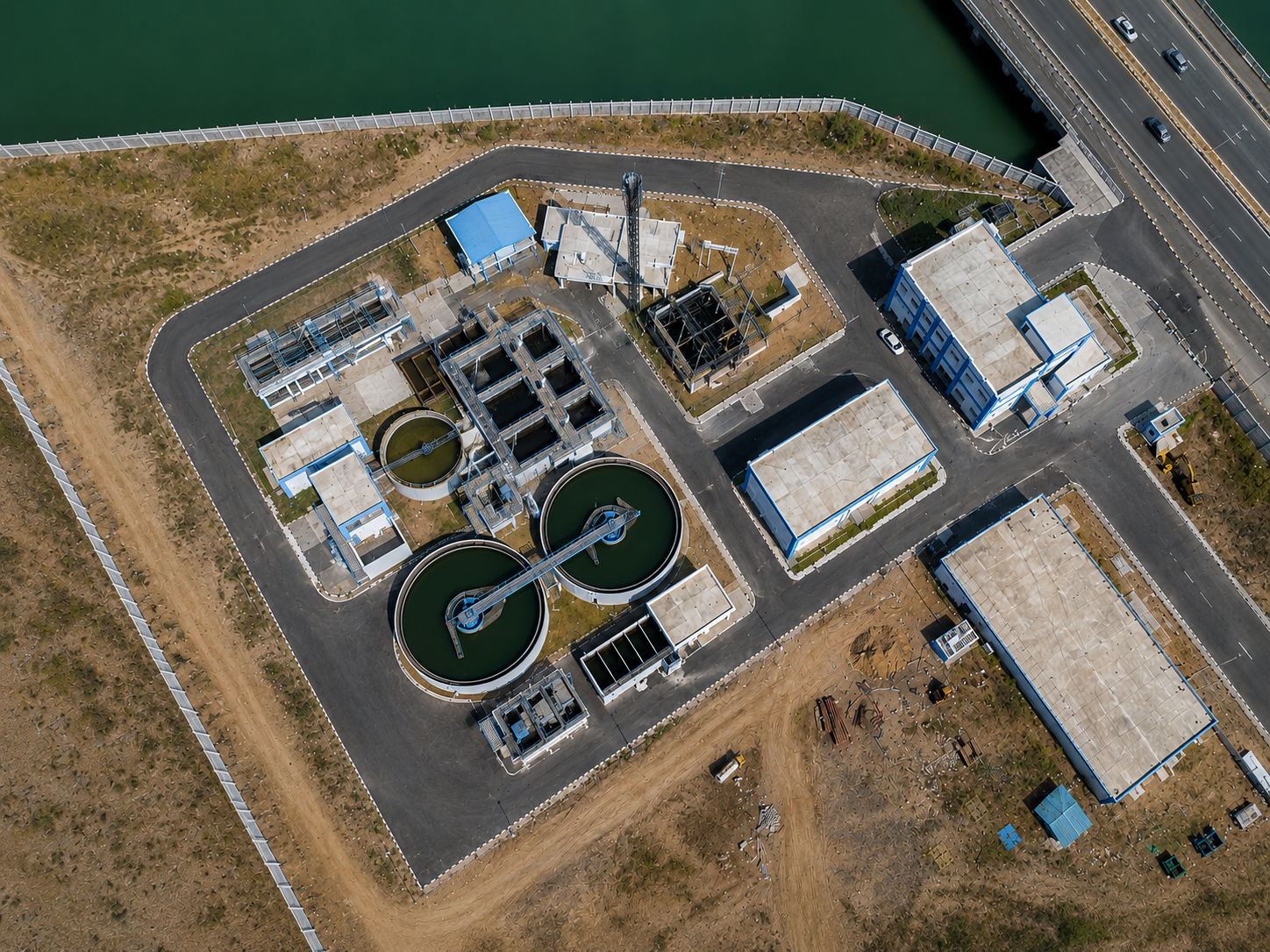
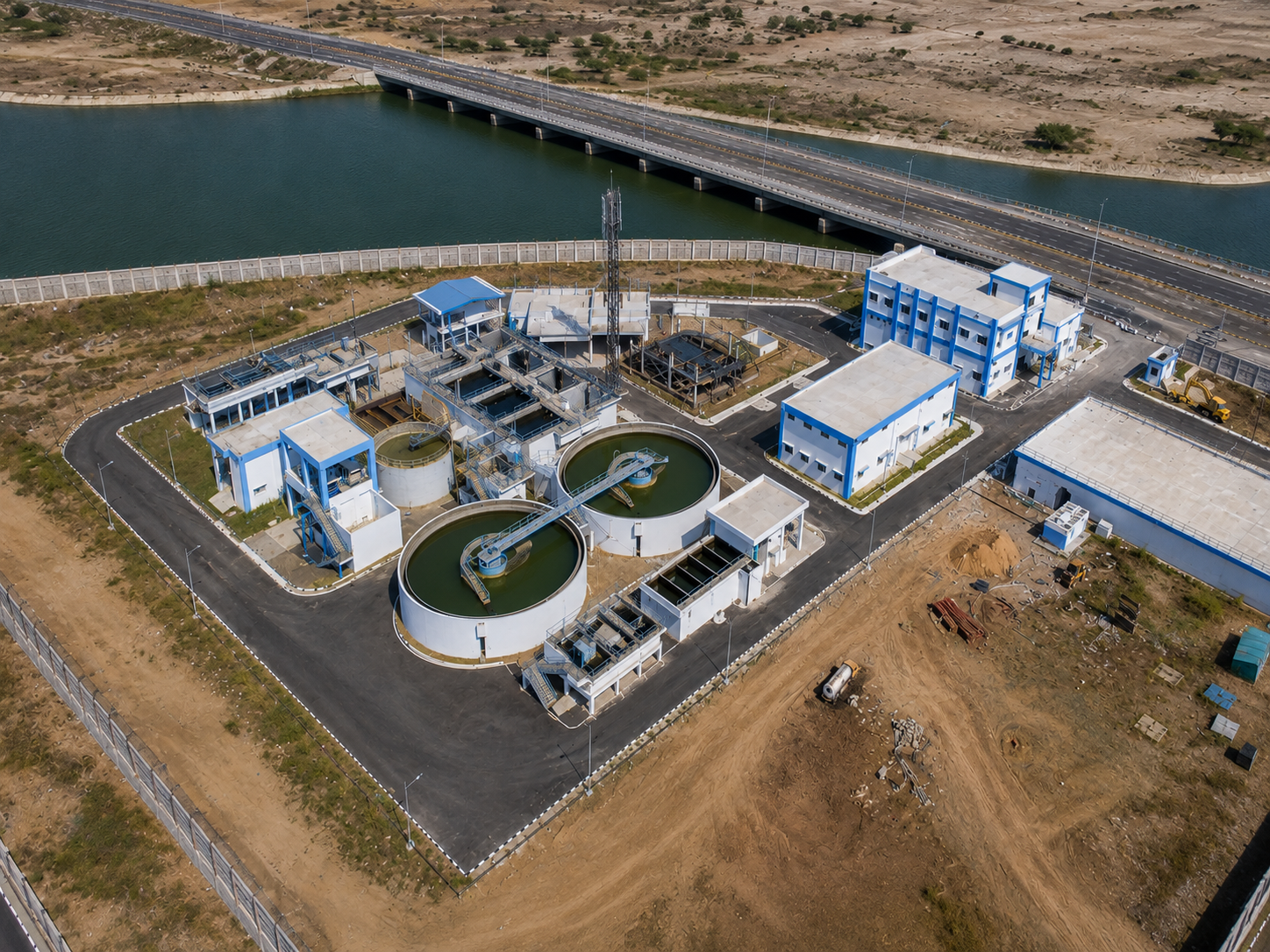
Dholera sits in a region where natural water availability drops to around 260 cubic meters per capita. India's national average is roughly 1,500. The water scarcity threshold is anything below 1,000. The rivers near Dholera — the Sabarmati and its tributaries — are ephemeral. They flow during monsoon and dry up for the rest of the year. Any city built here has to solve water before it builds anything else.
The Gujarat government's answer was the Narmada Canal, a 532-kilometer engineering project that carries water from the Narmada River across the state. Dholera SIR taps into the Saurashtra Branch Canal, which feeds a dedicated water treatment plant at Pipli. That plant is the starting point of everything — the first link in a chain that ends at your kitchen tap or at a factory cooling tower 500 meters away.
The drinking water treatment plant is Dholera's most critical infrastructure asset. Built by SPML Infra Limited at a cost of ₹94.85 crore, it takes raw water from the Narmada Canal system and processes it through a multi-stage treatment train to produce potable water that meets Bureau of Indian Standards.
The treatment process follows a proven sequence. Raw water first enters coagulation tanks where chemicals are added to destabilize suspended particles. These particles clump together in flocculation chambers, forming larger aggregates that settle out in sedimentation basins. The clarified water then passes through rapid sand filters to remove remaining fine particles. Finally, chlorine disinfection eliminates pathogens before the treated water enters the Clear Water Reservoir.
The Clear Water Reservoir holds approximately 16 to 17 million liters — enough to buffer a full day's supply if the canal intake temporarily stops. From there, a pumping station rated up to 150 MLD pushes treated water through a 121 MLD transmission main to the Master Balancing Reservoir, a 10 million liter ground-level tank that acts as the city's pressure buffer. From the balancing reservoir, water flows into the network of elevated storage tanks spaced 500 meters apart across the Activation Area.
The entire system is designed for 24/7 supply. Unlike most Indian cities where water comes on a schedule — two hours in the morning, two in the evening — Dholera's treatment plant runs continuously. The combination of the Clear Water Reservoir, Master Balancing Reservoir, and elevated tanks creates enough storage to maintain pressure around the clock, even during peak demand hours.
Every liter of water that enters Dholera eventually becomes wastewater. Showers, kitchen sinks, factory floor washing, cooling tower blowdown, laboratory discharge — all of it flows into the drainage system. The question is what happens next. In most Indian cities, the answer is "dump it in the nearest river." In Dholera, the answer is "treat it and use it again."
Dholera operates two separate wastewater treatment systems, one for domestic sewage and one for industrial effluent. They are physically separate plants with different treatment processes, different standards, and different end uses. Mixing them would be dangerous — industrial chemicals in drinking water pipes, or bacteria from sewage in semiconductor cooling systems. The separation is deliberate and total.
The Sewage Treatment Plant handles everything that comes from residential, commercial, and institutional buildings. With an initial capacity of 10 MLD, scalable to 30 MLD, it processes domestic wastewater through biological treatment — microorganisms break down organic matter in the sewage, reducing biological oxygen demand and removing pathogens.
The treated sewage does not leave the city. It enters the recycled water network, a parallel piping system that runs 81 kilometers across the Activation Area. This recycled water feeds industrial zones, landscape irrigation, and non-potable building uses like toilet flushing and air conditioning cooling. The result: factories consume treated wastewater instead of drinking water, freeing up Narmada Canal supply for human consumption.
The STP infrastructure includes six intermediate pumping stations and one terminal pumping station that move sewage across the city to the treatment plant. A 7.5 million liter master balancing reservoir within the sewage network prevents overflow during peak flow periods. The entire system is monitored through SCADA, with real-time data flowing to the Smart Command Center.
Industrial wastewater is a different beast. A semiconductor fab produces chemical-laden effluent containing solvents, acids, and heavy metals. A data center produces warm cooling water with biocides. A pharmaceutical plant produces organic compounds that require specialized biological treatment. Each industry's waste is unique, and a single treatment plant cannot handle all of them.
The Common Effluent Treatment Plant (CETP) is designed for this variability. With an initial capacity of 20 MLD, scalable to 60 MLD, it accepts industrial discharge from multiple sectors through a dedicated collection network. The treatment process includes primary neutralization (balancing pH), chemical precipitation (removing heavy metals), biological treatment (breaking down organic compounds), and advanced filtration.
The CETP enforces Zero Liquid Discharge. No untreated industrial wastewater leaves the city boundary. Every drop is either recycled back to the factory that produced it or converted to solid waste for safe disposal. This is not voluntary. It is a compliance requirement written into every industrial plot allotment. Companies that cannot meet ZLD standards do not get built at Dholera.
The entire water network runs on two parallel pipe systems installed during initial construction. The first carries potable water from the WTP to homes, offices, and food processing facilities. The second carries recycled water from the STP and CETP to industrial zones and non-potable uses.
The pipes are color-coded to prevent cross-connection. Every building connection point has separate meters for potable and recycled water. Every industrial plot has two water connections — one from the drinking water network, one from the recycled water network. The dual system is not an upgrade or a retrofit. It is the baseline design, installed before any building was constructed.
| Component | Capacity | Purpose | End Use |
|---|---|---|---|
| WTP | 50 MLD (→150) | Drinking water treatment | Homes, offices, food processing |
| STP | 10 MLD (→30) | Domestic sewage treatment | Recycled water network |
| CETP | 20 MLD (→60) | Industrial effluent treatment | Factory reuse, ZLD compliance |
| Desalination | 40 MLD (planned) | Supplemental freshwater | Long-term supply security |
Dholera is planning for a future where the Narmada Canal may not be enough. A 40 MLD desalination plant is in development, with a construction cost of ₹276.75 crore and total project cost of approximately ₹499 crore. The plant will take seawater from the Gulf of Khambhat, desalinate it using reverse osmosis, and blend the output with Narmada-treated water to increase the city's total freshwater capacity.
The desalination plant is not a应急 measure. It is a strategic hedge. As Dholera's population grows from the current activation area to the full 920 square kilometer SIR, water demand will eventually exceed what the Narmada Canal can reliably deliver, especially during drought years when the river flow drops. Having desalination capacity ready means the city never faces a water crisis even if the canal supply is curtailed.
The entire water system — WTP output, reservoir levels, pressure at each elevated tank, flow rates in every pipeline, STP effluent quality, CETP discharge parameters — feeds into the SCADA network connected to the Smart Command Center. Operators at the ICCC see real-time data on water levels, treatment chemical dosages, flow rates, and quality parameters across the entire network.
If a pipe bursts, pressure sensors detect the drop within seconds and isolate the affected section. If the WTP output quality deviates from standards, alarms trigger automatic chemical adjustment. If an industrial discharge exceeds CETP design parameters, the system rejects it at the collection point before it enters treatment. This is not reactive management. It is predictive and preventive, operating around the clock without human intervention for routine operations.
See how treated water reaches every building through elevated storage tanks.
Explore the Water Tank Network →Learn how Zero Liquid Discharge ensures no wastewater leaves the city.
Read about Zero Liquid Discharge →